
MYC Presents at National Conference
 National Webinar on Chronic Absenteeism & Youth Homelessness
National Center for Homeless Education (NCHE) | February 25, 2026
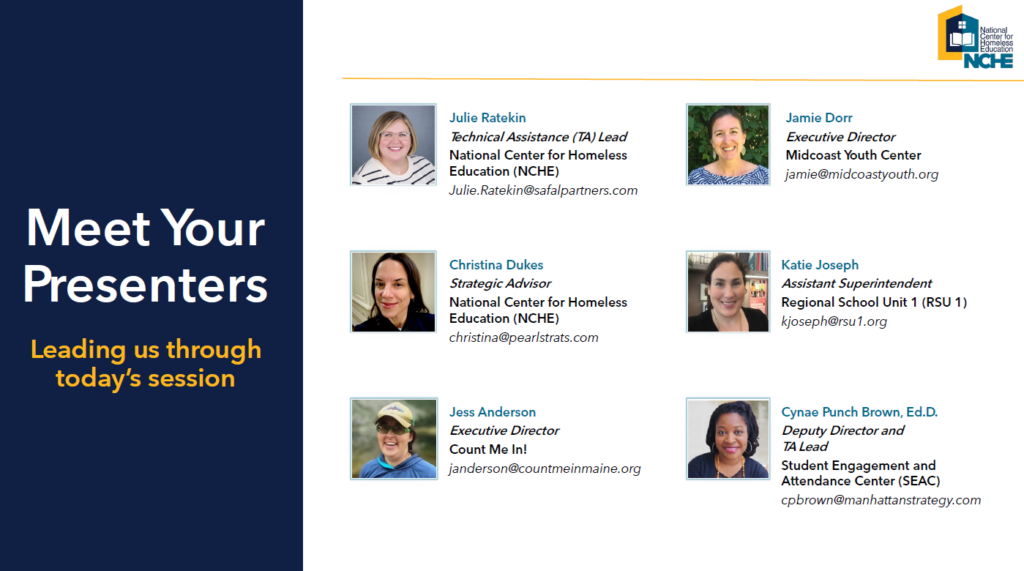
MYC was recently spotlighted in a national webinar hosted by the National Center for Homeless Education (NCHE) — the federally-funded technical assistance center for the U.S. Department of Education’s Education for Homeless Children and Youth (EHCY) Program. MYC Executive Director Jamie Dorr and RSU 1 Assistant Superintendent Katie Joseph presented alongside Count Me In! Executive Director Jess Anderson and NCHE/federal staff.
The webinar, “In School Every Day: Addressing Chronic Absenteeism Among Children and Youth Experiencing Homelessness,” drew 250 attendees from across the nation, with strong representation from Maryland, Alabama, Nevada, California, Illinois, Michigan, and New Jersey. MYC staff working in our youth housing programs attended the session.
THE ISSUE: CHRONIC ABSENTEEISM & YOUTH EXPERIENCING HOMELESSNESS
Chronic absenteeism is defined as missing 10% or more of the school year for any reason — excused or unexcused. It is distinct from truancy (which counts only unexcused absences) and is a more accurate indicator of educational risk.
Key national data points presented:
- 1 in 4 U.S. students (28%) was chronically absent in the 2022–23 school year.
- Children and Youth Experiencing Homelessness (CYEH) are chronically absent at nearly double the rate of the overall student population — in California, 30.7% of CYEH vs. 21.7% of low-income housed students in 2024–25.
- School mobility compounds the problem: students who change schools once are four times more likely to be chronically absent (Utah data).
- Chronic absenteeism costs school districts real funding: Oakland Unified lost an estimated $55M; Coeur d’Alene forfeited $4.8M in a single year.
The educational consequences are significant. NYC data showed that CYEH who were NOT chronically absent passed state assessments at the same rate as low-income housed peers (38% vs. 37%). Among chronically absent CYEH, only 12% achieved proficiency — making clear that homelessness itself is not the determining factor; attendance is.
McKINNEY-VENTO ACT: THE LEGAL FRAMEWORK FOR MYC’S MSCYEH WORK
The McKinney-Vento Homeless Assistance Act (Subtitle VII-B) is the primary federal law governing educational rights for children and youth experiencing homelessness. It is directly relevant to MYC’s Merrymeeting Support Collaborative for Youth Experiencing Homelessness (MSCYEH) program. Key provisions include:
- Immediate enrollment: Immediate enrollment rights:
- Local Educational Agencies (LEAs) must immediately enroll CYEH in school even if they have missed application or enrollment deadlines — removing a key barrier that could otherwise compound absenteeism.
- Barrier removal: Barrier removal mandate:
- State Educational Agencies (SEAs) and LEAs are required to develop, review, and revise policies that remove barriers to identification, enrollment, and retention of CYEH — explicitly including barriers caused by outstanding fees, fines, or absences.
These legal protections mean that MYC’s case managers — operating across RSU 1, MSAD 75, Brunswick, and Richmond school districts — are working within a defined rights framework when they advocate for unstably housed youth. The law supports and reinforces MYC’s whole-person, barrier-removal approach.
MYC & MSCYEH: NATIONAL HIGHLIGHT AS A REPLICABLE MODEL
MYC’s Merrymeeting Support Collaborative (MSCYEH) was featured as a field example of effective school-community partnership. The schools have identified nearly 300 unstably housed students, and approximately 75-100 are engaged in our program this year through three full-time case managers embedded across four school districts. Services span:
- Housing navigation and transitional housing (STEP Up)
- Medical and mental health appointment support
- Workforce development and financial literacy
- Educational advocacy and legal navigation
- Network connections to emergency assistance and other community supports
- No-barrier programming: clothing closet, laundry, free nightly meals, and home stays for homeless youth
The webinar’s suggested Tier 1 interventions aligned directly with MYC’s program model — a Maslow’s Hierarchy approach organized around Stability (basic needs first), Engagement (building connection and skills), and Adventure (confidence through healthy risk). This framework was presented to a national audience of educators, homeless liaisons, and youth-serving organizations as an successful approach.
KEY NATIONAL TAKEAWAYS & IMPLICATIONS FOR MYC
The webinar reinforced several principles already embedded in MYC’s work, while also offering strategic context:
- Attending school is itself an intervention: Research confirms that improving attendance — even without other systemic changes — raises graduation and college attainment rates for youth experiencing poverty.
- Data drives action: LEAs are encouraged to segment absenteeism data by housing status and school mobility — the very populations MYC’s MSCYEH case managers serve daily.
- Community partnerships are essential: Shelters, human services, and youth-serving nonprofits like MYC are identified in the national guidance as critical partners for addressing root causes that schools alone cannot solve.
- Punitive approaches backfire: National best practices explicitly recommend against suspension or harsh penalties for excessive absences — reinforcing MYC’s non-punitive, trauma-informed philosophy.
MYC’s presence on this national platform — alongside federal technical assistance staff and statewide attendance advocates — reflects the strength and replicability of the MSCYEH model and positions the organization as a recognized leader in this space.
Resources: NCHE (nche.ed.gov) | Count Me In! (countmeinmaine.org) | SEAC (ed.gov/seac) | Attendance Works (attendanceworks.org)
The full NCHE slide deck is available if you would like to read more.
Key take-aways:
- Maine has approximately 170,000 students Pk-12 in just over 600 public schools. In 2024-2025 nearly 1 in every 4 Maine students experienced chronic absenteeism. For economically disadvantaged students, that number jumped to over 1 in 3 students.
- Students experiencing homelessness had a 50% chance of being chronically absent. In the catchment area of MYC’s work, there are nearly 7000 students in 4 different school districts reaching across 3 counties with nearly 300 experiencing housing instability.
- The McKinney-Vento Homeless Assistance Act (Subtitle VII-B) is the primary federal law governing educational rights for children and youth experiencing homelessness. It guides the work of MYC’s Merrymeeting Support Collaborative for Youth Experiencing Homelessness (MSCYEH) program.
- MYC provides programs that bring kids in early and build the relationships that form the foundation of being able to engage young people when and if life becomes more challenging – including housing.
- RSU 1 Alternative Pathways Program and Credit Pathway Program – homebase & family feel – which grew out of the disruption of the pandemic and the resulting increased absenteeism. 66% of students enrolled have improved their attendance and are no longer chronically absent. Graduation rate has increased from 88% to 94% and McKinney-Vento students are a big part of this improvement.
- RSU 1 Logistical support including School-based Health Center instituted & vehicles that allow RSU 1 and MYC to get these vulnerable young people to the care they need.
- RSU 1 Cell phone bans at school have also improved culture for all which improves absenteeism.
- Note that Maine Integrated Youth Survey highlights the high rate of ACES – Adverse Childhood Experiences in Maine and especially in Sagadahoc County.
- Folks wanted to understand how our ‘no barrier’ programs are funded (don’t we all!)
- Feedback from the group – “Thank you – very inspiring”